By: Carolanne Korolowicz
I’ve always heard my grandmother saying she was from Barcroft more often than saying she was an Arlingtonian. Though a niche distinction, for those from there– it’s an important one. When she tells stories of her upbringing, it is always painted like a Norman Rockwell scene. She speaks of farmettes, relatives living next door, days on the playground, and a community truly caring for one another. As I started my Barcroft research, outside of just generations of familial stories, it was hard to take in all of the information to write a concise article due to every happening, resident, and home being documented with great importance. Whether a neighbor started a business or went to go visit their cousins in the country, the community took a genuine interest.
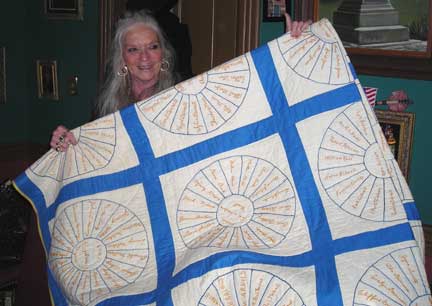
(Donna Lee (Kirchner) Wilson, my grandmother, with the 1948 Barcroft Community Quilt, 2009)
The early settlers of Barcroft considered themselves pioneers headed west. Post-Civil War, real estate developers saw investment opportunities in Northern Virginia. With (relatively) easier access to Washington due to advancements in transportation, these subdivisions were heavily advertised to city folk looking to escape to the “country air”. There was an early, and overall unsuccessful, attempt to subdivide the land that makes up modern-day Barcroft by Frank Corbett. In 1886, he hired surveyors to lay out a 40-acre subdivision amongst his 162-acre farm, believing the existing train station nearby would be a popular selling point. However, his lots failed to sell. The issue was that he made the tracts too large, pricing out the demographic looking for these properties—middle-class, federal workers. After his death in 1897, a new developer swooped in on the purchase of his remaining lots, starting Barcroft's second wave.
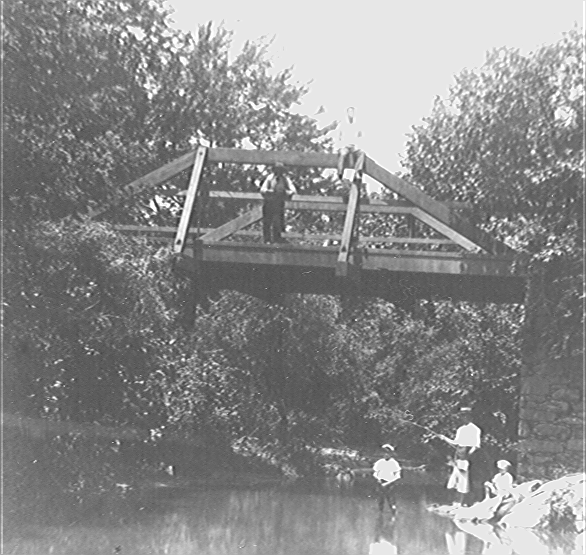
(Original Columbia Pike Bridge over Four Mile Run)
In 1903, Abbie Galt Fox purchased the balance of Corbett’s property. She partnered with her son-in-law, Stephen Prescott Wright, to help subdivide, manage and finance the “new” Barcroft. As the lots began to sell, Barcroft expanded both north and to the east. Apartment complexes began to emerge alongside Columbia Pike. The rural village over the next couple of decades would start to become the neighborhood we recognize today.
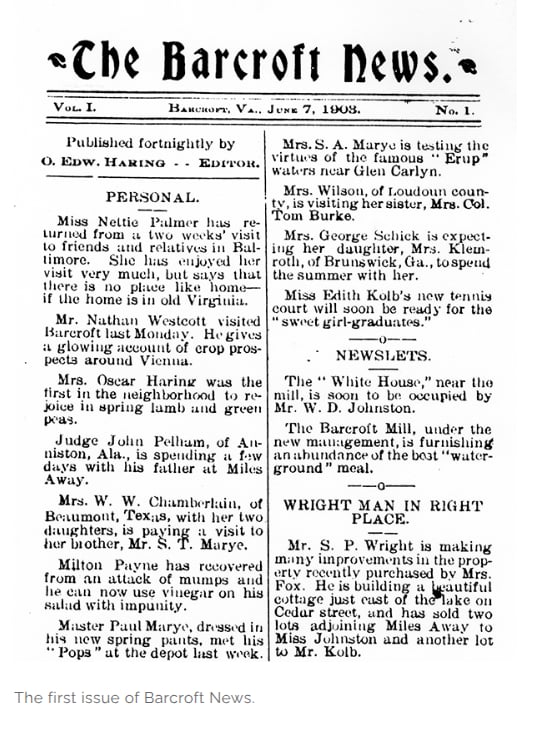
(First Issue of The Barcroft News, 1903)
What is unique in Barcroft’s timeline is that a strong sense of community emerged as quickly as the new developments. In June 1903, a young resident, Eddie Haring, took it upon himself to print the first official Barcroft News. The newsletter was compiled of personal news (similar to someone making a Facebook status today), neighborhood updates, opinion pieces and letters to the editor. One in particular really shows the hope and pride residents had in their new hamlet:
“Editor Barcroft News: I have to thank you for the second number of your dear little cracker jack of a paper. It is very neatly gotten up and clearly typed--an acorn, as it were, destined to become an oak. Barcroft will blossom out into a village in the near future--as soon as the bridge across the Potomac is completed--and then the people of Washington will find out what a healthy place is within reach of the city, that there malaria and "sketers" are unknown and that the pure water from the Blue Ridge mountains is curative of any kidney or liver complaints. The electric cars will soon "skite" across the landscape and slap one down into the city in twenty minutes, or maybe the Southern railway will wake up and realize that the Bluemont division is as good paying a branch as any on their whole system and perhaps worth a better passenger service, and they will then not use it as a dumping ground for antiquated locomotives and stock in general…I want to come back to Barcroft." E.H.KLEMROTH
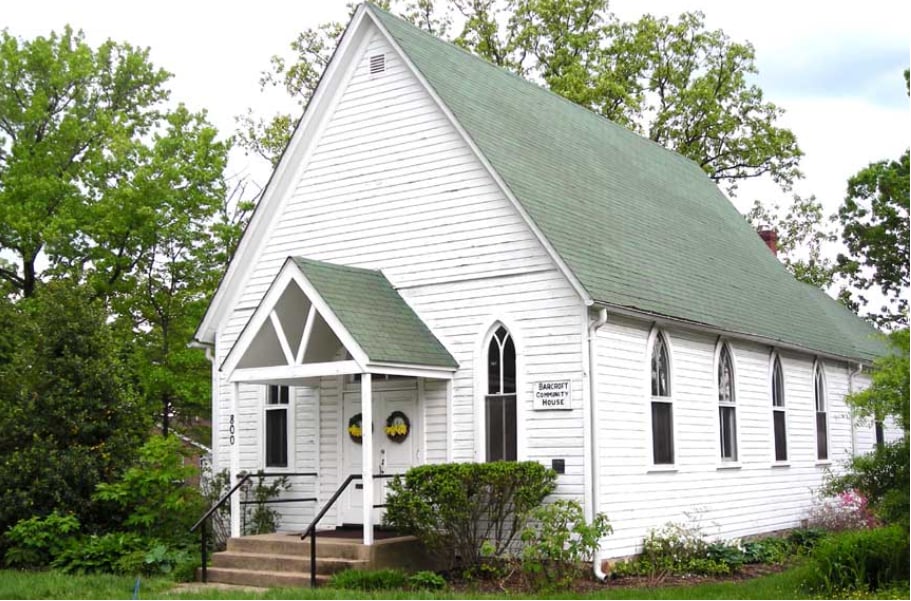
(Barcroft House, 2008)
Besides hyper-local journalism, Barcroft also established a civic league and public school early in its history. In 1906, Arlington County required a 10-student minimum for schoolhouses. Desperate to swell the numbers, the teacher, Mrs. Edith Fairfax, enrolled her four-year-old daughter to meet the minimum. By 1907, the student minimum was no longer an issue and the population had outgrown Mrs. Fairfax’s home, which prompted the need for a community space that could house school, act as a church, and community center. The Barcroft School and Civic League (BSCL) found creative ways to finance the project– the community performed plays, hosted lawn parties and suppers. The Barcroft Community House, located on 800 S. Buchanan Street, was completed by 1908. Barcroft School continued to operate there until 1925, when it was moved to its current location on 625 S. Wakefield Street. Today, The BSCL is still in operation, using the Barcroft House to continuously host neighborhood events in an effort to maintain the community spirit formed over a century ago.
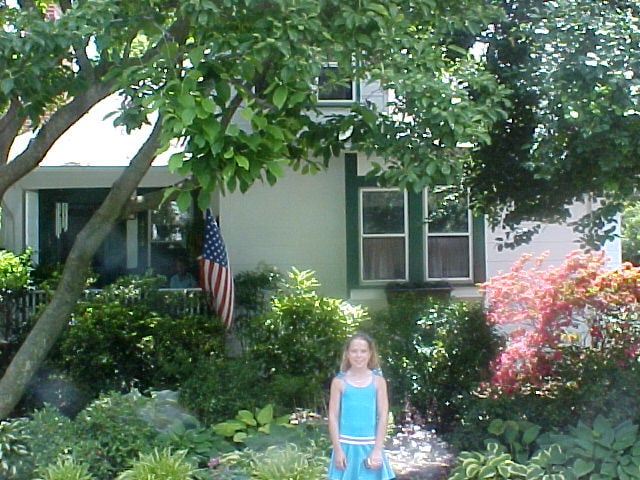
|Standing out front my great-great-great grandparent’s house in Barcroft, 2005)
Many of the homes my relatives purchased in Barcroft no longer exist, they’ve been traded for larger models, but when I take a short cut through or show homes in the neighborhood, I take note of the early homes tucked away, unannounced. I’ve always felt a connection, maybe due to the familial ties, but maybe the love, dedication and spirit of the neighborhood’s “pioneers” remains palpable. When researching Barcroft, the accounted history is not made up of extraordinary stories, well-known figureheads, or groundbreaking events, but a series of personal experiences. Ones that I, the author of this brief article, could never do justice to relaying. What made Barcroft unique, and an identity worth claiming, was the genuine recognition of everyday, hardworking individuals building something for each other and the future.