Question: How would you compare current weakening market conditions to what happened in 2022, when rates increased quickly?
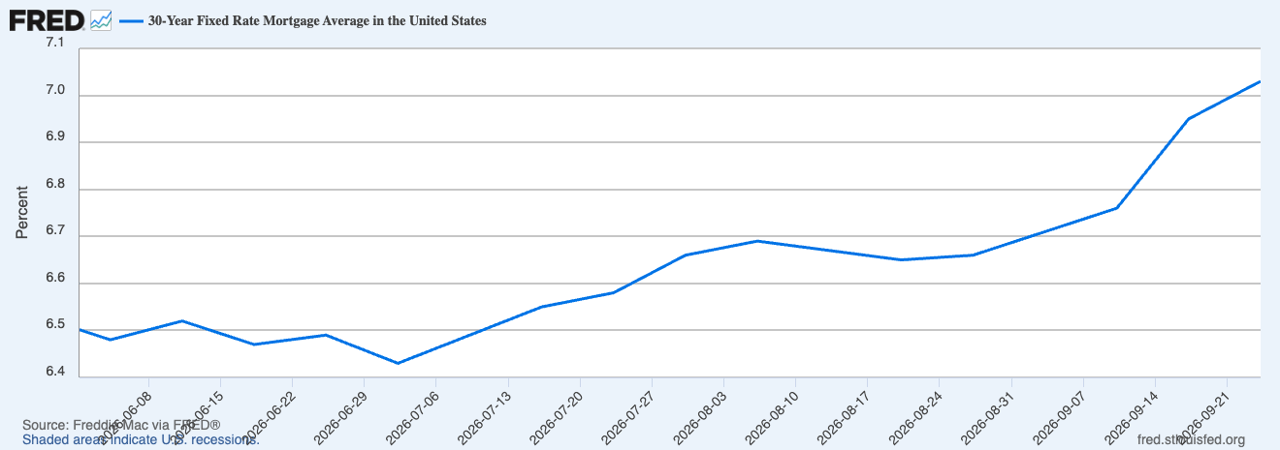
Answer: The DC Metro/Arlington real estate market has slowed considerably, driven by mortgage rates that have climbed since July, rapidly in September. Showings are down, listings are taking longer to sell, and buyers have become increasingly cautious.
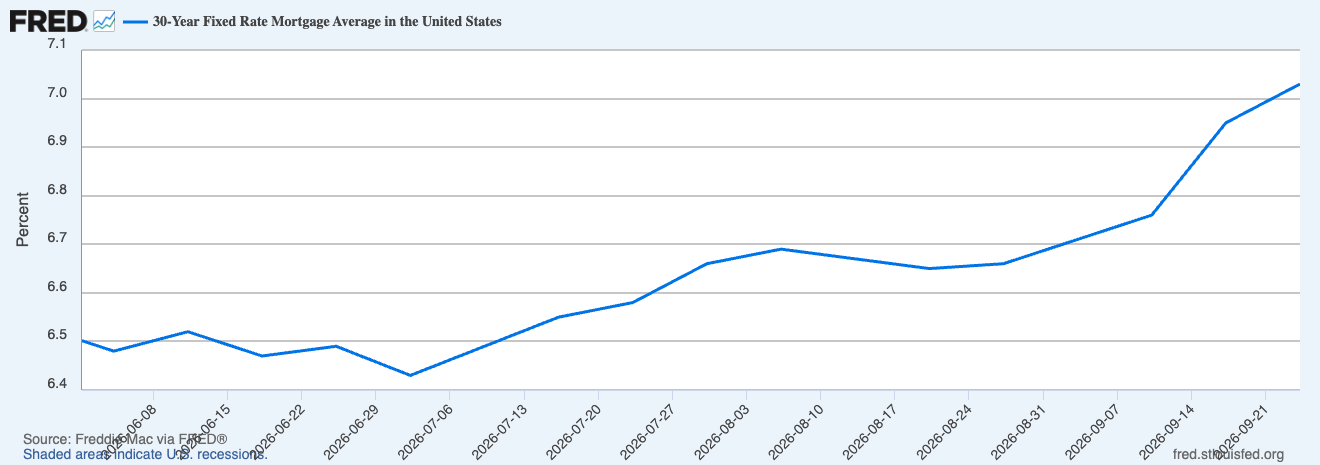
Average 30yr Fixed Rate Mortgage in the US since June 1 2026
The obvious comparison is 2022, when mortgage rates rose at extraordinary speed and abruptly ended one of the most competitive markets we have ever experienced. The current rate increase is much smaller, but it’s having a significant effect because the 2026 market was in a more vulnerable position than in 2022.
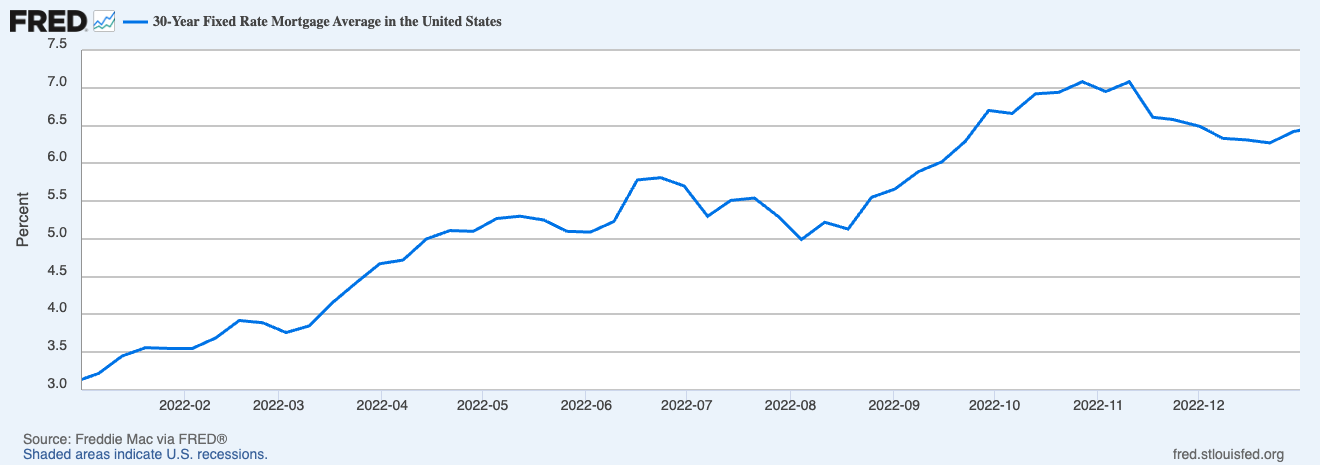
Average 30yr Fixed Rate Mortgage in the US in 2022
The 2022 rate shock hit a market with extraordinary buyer demand and almost no available inventory. Buyers were eager to purchase a home.
The 2026 market has less cushion than in 2022. Rates and prices made payments more uncomfortable, buyer enthusiasm was lower, and we had considerably more inventory relative to demand.
What happened in 2022
During the first half of 2022:
- 60% of Arlington homes went under contract within ten days
- Median cumulative days on market was seven
- Nearly 69% of homes sold at or above the original asking price
- Almost 49% of homes sold above the original price
- Only 14% of homes required a price reduction
By the second half of 2022:
- The share going under contract within ten days fell to 34%
- Median cumulative days on market increased to 21.5 days
- Only 34% sold at or above the original price
- Price reductions increased to 36%
- The share selling below 95% of the original price tripled from 9% to 27%
Some of that reflects normal seasonality, but the same-period comparison confirms a substantial shift. Compared with the second half of 2021, sales fell 33%, the share selling at or above the original price declined eleven points, and price reductions increased six points.
However, prices did not collapse. The median sale-to-original-ask-price declined from 99% to 97.7%; a modest price correction. The larger correction occurred in transaction volume, competition, and buyer leverage.
Less demand cushion to absorb a smaller rate shock
The first half of 2026 was strong by most historical standards, but it was less competitive than early 2022. Sales volume was 22% lower, the share selling at or above the original price fell from 69% to 59%, and the share selling above the original price declined from 49% to 37%.
Months of supply (a metric that measures supply and demand) shows the difference clearly. During July and August 2022, Arlington averaged 1.5 months of supply (lower MoS favors sellers). During the same months of 2026, it averaged 2.5 months of supply, approximately 60% higher.
The result: even though the current rate shock is small, relative to 2022, it’s resulting in measurable market changes. In the Greater DC Area, during the week ending September 20:
- Showings were down 12.7% from the prior year
- New contracts were down 12.5%
- New listings were up 7.3%
- Active listings were up 18%
- Canceled listings were up nearly 66%
The amount of buyer attention on each listing is declining even faster than raw showing activity. Weekly showings per active listing fell approximately 26% regionally and 22% in Arlington.
Even though Arlington recorded 54 contracts compared with 52 during the corresponding week last year, a sign of consistent demand activity, the homes securing contracts had been on the market for a median of 52 days, compared with 32 days a year earlier, suggesting that buyers are deal-hunting for motivated sellers rather than jumping on new listings.
One week should not be overstated, but the weekly data is also supported by longer-term trends I’ve been watching through this summer.
Six trends to watch through 2026
- A modest decline in buyers can produce a larger decline in seller leverage.
Three interested buyers can create an aggressive bidding war. One interested buyer may still produce a sale, but with inspections, contingencies, and negotiation.
Removing only one or two buyers per listing can have a much larger effect on competition than on the number of eventual sales. The market can continue producing sales while the negotiating environment changes abruptly.
- The gap between the best homes and everything else will widen.
Scarce, well-located and properly priced homes can still sell quickly. Dated, compromised or over-priced properties are more likely to accumulate time on market.
This will create contradictory anecdotes. One seller may receive multiple offers while another nearby property sits for months. Both can accurately represent the same market.
- Sellers will adjust more slowly than buyers.
Buyers feel higher mortgage rates immediately. Sellers usually base their expectations on comparable sales from several months earlier.
That lag creates stale inventory because sellers initially price for the previous market. Correct initial pricing will become increasingly important.
- More sellers may withdraw instead of reducing their price.
Canceled listings across the Washington DC region were 66% higher than one year earlier.
Some sellers must move and will eventually accept the market. Others will cancel rather than sell below expectations. Those unsuccessful transactions never become lower comparable sales, which suggests stronger pricing than what really exists.
It can also create a misleading year-end signal. If inventory or months of supply falls because sellers withdraw for the winter, that does not mean buyers have returned and absorption has increased.
- Published prices may look healthier than the underlying market.
Median and average prices only measure homes that successfully close, which includes a higher weight of the most desirable homes than exists across the entire market. Unsuccessful sales that fail to meet seller expectations are not represented in sold data.
Recorded prices also exclude concessions, including closing-cost assistance, rate buydowns, and inspection-related credits and repairs. The effective terms can move in the buyer’s favor without headline prices showing much change.
- Limited inventory should prevent a broad collapse, but it cannot preserve seller leverage.
Arlington and most DC area sub-markets are still undersupplied (favorable for sellers). That should support prices, particularly for property types with fewer alternatives like detached homes (as opposed to condos).
But limited inventory should not be confused with strong demand. Buyers are absorbing available homes more slowly, and sellers can’t assume that almost any reasonably attractive property will sell quickly and on their preferred terms.
What this means
The current market is not an exact replay of 2022. The 2022 rate shock was far larger, but it struck an extraordinarily competitive market with intense buyer demand and severe inventory scarcity.
The latest increase is hitting buyers who were already less enthused about the market due to high prices, high rates, low supply, and low leverage.
Despite the shifting market conditions, it’s more likely that the remaidner of 2026 results in more liquidity pain than price pain (for those who can wait): fewer sales, longer marketing times, fewer bidding wars, more concessions, more cancellations and a growing divide between the properties buyers compete for and those they avoid.
If you’d like to discuss buying, selling, investing, or renting, don’t hesitate to reach out to me at [email protected].
We have access to the most pre and off-market listings across the DMV of any brokerage and are happy to share what’s available with anyone who asks.
Below are some of our team’s pre/off-market listings, details and additional listings available by request:
- Ballston - 4BR/3.5BA/2,400sqft – Townhouse (2008) – N George Mason Dr Arlington VA 22203
- Mclean VA - 5BR/4.5BA/3,700 sqft – Detached Single Family (2023) – Randolph Rd Mclean VA 22101
- Falls Church VA – 5BR/4.5BA/4,000+ sqft – Detached (2017) – Brilyn Pl Falls Church VA 22046
- Capitol Hill (Washington DC) - 4BR/3.5BA/2,000 sqft – Rowhouse (1914) – South Carolina Ave SE Washington DC 20003